10 Standing Desk Exercises You Can Do in Under 5 Minutes

Boost your energy and reduce discomfort with these top 10 standing desk exercises: squats, push-ups, etc. Easy moves to stay active and productive at work.
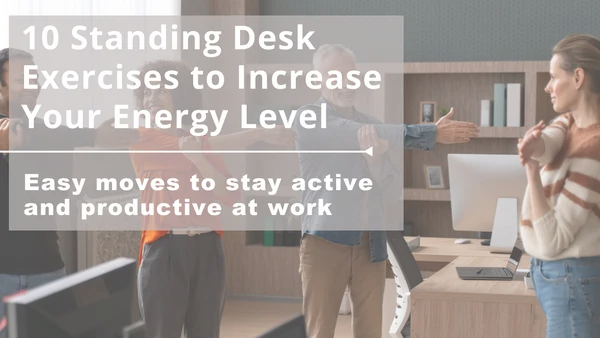
Table of Contents
For many people, finding a full workout block after work feels like a luxury, especially when the “getting started” steps (changing, heading out, setting up) kill your motivation before you begin.
Standing desk exercises solve that by turning spare moments into movement. In 30 seconds to 3 minutes, you can loosen up, boost circulation, and ease neck, shoulder, and lower-back tension, whether you’re replying to emails, waiting for a meeting, or hitting an afternoon slump.
Here are 10 simple desk exercises you can fit into your day with almost no setup.
1. Desk Squats

Desk squats work your quads, glutes, and core. Start with your feet shoulder-width apart. Extend your arms in front of you, brace your abs, and keep your chest lifted with a neutral back. Slowly lower into a squat, making sure your knees don’t track past your toes. If you need extra stability, lightly hold the edge of your standing desk for balance.
As you stand back up, press through your heels and rise with control. Aim for 8–12 reps per set, for 2–3 sets, resting 30–60 seconds between sets.
You can also turn this into chair squats. Use a chair as a depth guide, but don’t fully sit down—just tap the seat lightly, then stand back up. If your chair has wheels, lock the casters (or use a stable chair) so it doesn’t slide while you squat.
2. Calf Raises

Calf raises are one of the simplest desk exercises you can do. Stand with your feet shoulder-width apart, then slowly lift your heels so you’re balancing on the balls of your feet. Hold for a few seconds, then lower your heels back down with control. Repeat for 15–25 reps, for 2–4 sets, resting 30–60 seconds between sets.
Beyond building calf strength and muscular endurance, calf raises can also make a noticeable difference in how steady you feel when standing. One more bonus: you can do them either standing or seated. The main difference is intensity and muscle emphasis—standing calf raises use more of your body weight and typically feel more challenging overall, while seated calf raises reduce the load and shift more focus to the deeper calf muscle (the soleus), which is especially helpful for stamina during long periods of standing and walking.
3. Arm Circles

Arm circles are a simple, effective at-home exercise. To do them, raise both arms out to the sides until they’re straight and level with your shoulders, then make small circles forward for 30 seconds and backward for 30 seconds. You can also try a “shoulder-tap circle” variation: place your fingertips on your shoulders and draw bigger circles by rotating your shoulders. Another commonly suggested option is to use one hand to gently press the area under your opposite armpit for support, then make larger circles with the free arm—about seven circles forward and seven backward.
This movement engages both deeper stabilizers around the shoulder blade (such as the subscapularis) and larger surface muscles like the trapezius and latissimus dorsi. Practiced consistently for about 4–7 minutes a day, it can help tone the upper arms and define the shoulder line, while also improving circulation. Over time, it may reduce shoulder and neck tightness, support better posture, and ease the strain that can contribute to discomfort such as lower-back pain.
4. Desk Push-Ups

Desk push-ups are a bodyweight exercise you can do using the edge of your desk. Compared with a standard floor push-up, they’re more approachable and especially useful if you want a quick way to loosen up and get your muscles working during the workday.
To do a desk push-up, place your hands on the desk edge slightly wider than shoulder-width. Step your feet back until your body forms a straight line from head to heels. Brace your core and squeeze your glutes to stay stable. Inhale as you slowly lower your body until your chest moves closer to the desk, keeping your elbows at about a 45-degree angle from your torso. Then exhale and press yourself back to the starting position.
Aim for 8–12 reps per set. Desk push-ups strengthen your chest, triceps, and the front of your shoulders. They can also support better posture and reduce upper-body tightness, making it easier to stay comfortable—and focused—while you work.
5. Side Lunges

Side lunges are especially helpful for office workers who sit for long hours, because they help open up tight hips and wake up your lower body after long periods of sitting.
Start by standing with your feet hip-width apart and bracing your core. Step out into a wide stride to one side, keeping your toes pointing forward. Bend the knee on the stepping side and sit your hips back, while keeping the other leg straight. Throughout the movement, keep your chest lifted, your back neutral, and your heel flat on the floor.
To return, push firmly through the bent leg to come back to the starting position. Make sure your knee tracks in line with your toes and doesn’t push past the front of your foot. Because side lunges require an upright chest and a straight back, they’re also a great way to counter the rounded-shoulder, slouched posture that can build up after hours at a computer.
6. Balancing Exercises

Balancing exercises are a great way to build core and lower-body strength. For older adults, regular balance training has also been linked to about a 37% reduction in fall-related injuries.
You can practice balance work anytime at your standing desk, and use the desk for support the moment you feel unsteady. Start with a single-leg stand and hold for 10–30 seconds. To make it more challenging, lift one leg and extend it out to the side. Then switch legs and repeat. Throughout the movement, keep your torso tall and your eyes looking straight ahead.
7. Glute Squeeze

Glute squeezes are a simple, targeted exercise for activating and strengthening the glute muscles. By intentionally contracting your glutes, you can improve hip-extension strength and overall glute engagement. One of the best parts is how easy they are to fit into your day, you can do them standing or sitting.
To perform a glute squeeze, deliberately tighten both sides of your glutes as if you’re drawing them toward the center. When you’re doing it correctly, you may feel a subtle “lift” through your hips and pelvis, and your glutes should feel firm to the touch. If it’s hard to tell whether you’re engaging the right muscles, placing a hand on your glutes—or gently squeezing the muscle with your hand—can help you notice the difference between a true contraction and simply tensing your lower back.
For many people who sit for long hours, the glutes can become underactive, and other muscles (like the lower back and hamstrings) may start doing more of the work than they should. Practicing glute squeezes can help “wake up” the glutes, reinforce hip extension, and support a more neutral, stable pelvis—making it easier for your body to stay well-aligned and comfortable throughout the day.
8. Neck Stretches

Long hours at a desk often lead to neck and shoulder tightness, and that’s where neck stretches come in. They’re simple, effective, and easy to fit into your day. As a general routine, try 2–3 sets per day, doing 2–3 rounds per stretch, and holding each position for 15–30 seconds.
Start with gentle warm-ups, such as slow left-to-right head turns, side bends, and chin tucks. For side bends, think about keeping your neck “long” by reaching the crown of your head upward while you tilt your ear toward your shoulder. For chin tucks, glide your head straight back (as if you’re making a “double chin”) without tilting your head up or down.
Once you feel warmed up, you can add more targeted stretches. To stretch the upper trapezius, tilt your ear toward your shoulder and hold. To target the levator scapulae, rotate your head about 45 degrees and angle your nose toward your front pocket, then gently nod your chin down to deepen the stretch.
All stretches should feel comfortable and pain-free. If you notice any nerve-related symptoms—such as sharp or radiating pain, tingling, numbness, weakness, or dizziness—stop immediately.
9. Shoulder Shrugs

Shoulder shrugs are a simple upper-back move that mainly targets the trapezius, a large muscle that runs from the base of your skull down through your upper and mid back and helps control shoulder and neck movement. Done regularly, shrugs can help relieve the tight, “stuck” feeling that often builds up after hours at a computer.
To do a shrug, stand tall and look straight ahead. Let your arms hang naturally by your sides. Slowly lift your shoulders straight up toward your ears, aiming for a smooth, vertical motion (not rolling them forward). Pause briefly at the top, about 1–2 seconds, or up to 5 seconds if it still feels comfortable—then lower your shoulders back down slowly with control.
A simple starting point is 10 reps per set. Focus on staying relaxed through your neck and breathing normally throughout the movement.
10. Oblique Twists

Oblique twists are often shown as a seated floor exercise, but they come in many variations—including a standing version that works well at a desk. They can be especially useful for countering the stiffness that builds up from long hours of sitting, and for reinforcing better posture by getting your core involved. If you have an existing lower-back issue, keep the range small and stop if twisting causes discomfort.
To do standing oblique twists, plant your feet firmly on the floor—about shoulder-width apart or slightly wider—and keep a soft bend in your knees. Extend your arms out to the sides at shoulder height. Brace your core, keep your back tall, and rotate your torso gently from side to side. Try to keep your hips facing forward and let the movement come from your upper body rather than swinging your arms for momentum.
How to Keep Up with an Effective Exercise Routine at Work
Maintaining an exercise routine at work can be simple with a few strategic adjustments. First, set reminders to take regular breaks and move around. Whether it's stretching or a quick walk, these alerts help you stay active throughout the day.
Next, plan your schedule by blocking specific times for physical activity, treating it as an unmissable appointment. Pairing up with an accountability partner can also keep you motivated, encouraging each other to stick to your fitness goals.
Additionally, modify your workspace by using a standing desk or arranging items to encourage movement. Lastly, take active breaks by engaging in short physical activities instead of remaining sedentary during downtime. These small changes help boost energy and keep your routine consistent.
Boost Your Productivity with Standing Desk Exercises
Incorporating standing desk exercises into your daily routine offers a range of health benefits, from improving posture to increasing physical activity. Simple movements like desk push-ups, side lunges, and neck stretches effectively combat the negative effects of prolonged sitting or standing, promoting better well-being and productivity. By adding these exercises to your workday, you can boost energy levels, reduce discomfort, and create a healthier work environment.
We understand how challenging it can be to sit for long hours, impacting both your posture and productivity. That’s why at Dezctop, we focus on ergonomic solutions that enhance comfort and well-being. Our standing desks are designed to help you stay active, improve posture, and transform your work experience. Explore our ergonomic desks and accessories to create a workspace that promotes comfort, productivity, and success.
Related Articles Which May Interest You:
Tag


Dezctop